
Introducing Breakwater ASOC: An Agentic AI SOC for Connected Operations
Why we built Breakwater around the security work that protects a running business.
Consider a manufacturing plant where a supplier logs in for scheduled maintenance. Minutes later, an engineering workstation begins communicating with a device the security team cannot identify. The work order might explain the traffic. It does not show everything the workstation can reach. Production is still running.
The analyst can trace the connection to the workstation; the plant engineer knows the maintenance job but may not know the workstation's effective permissions. Restricting access could interrupt legitimate work. Leaving the connection open could expose production equipment. The team needs to establish what was authorized and what happened before choosing either course.
The records needed for that decision were created for different purposes. A device inventory reflects what a collector could see from a particular network position. A software finding refers to a code revision that may differ from the deployed build. Monitoring describes activity during a particular interval. Each offers part of an answer. Matching them to systems, owners and operational consequences takes work that a security team must repeat as its environment changes.
#Connect the evidence to the decision
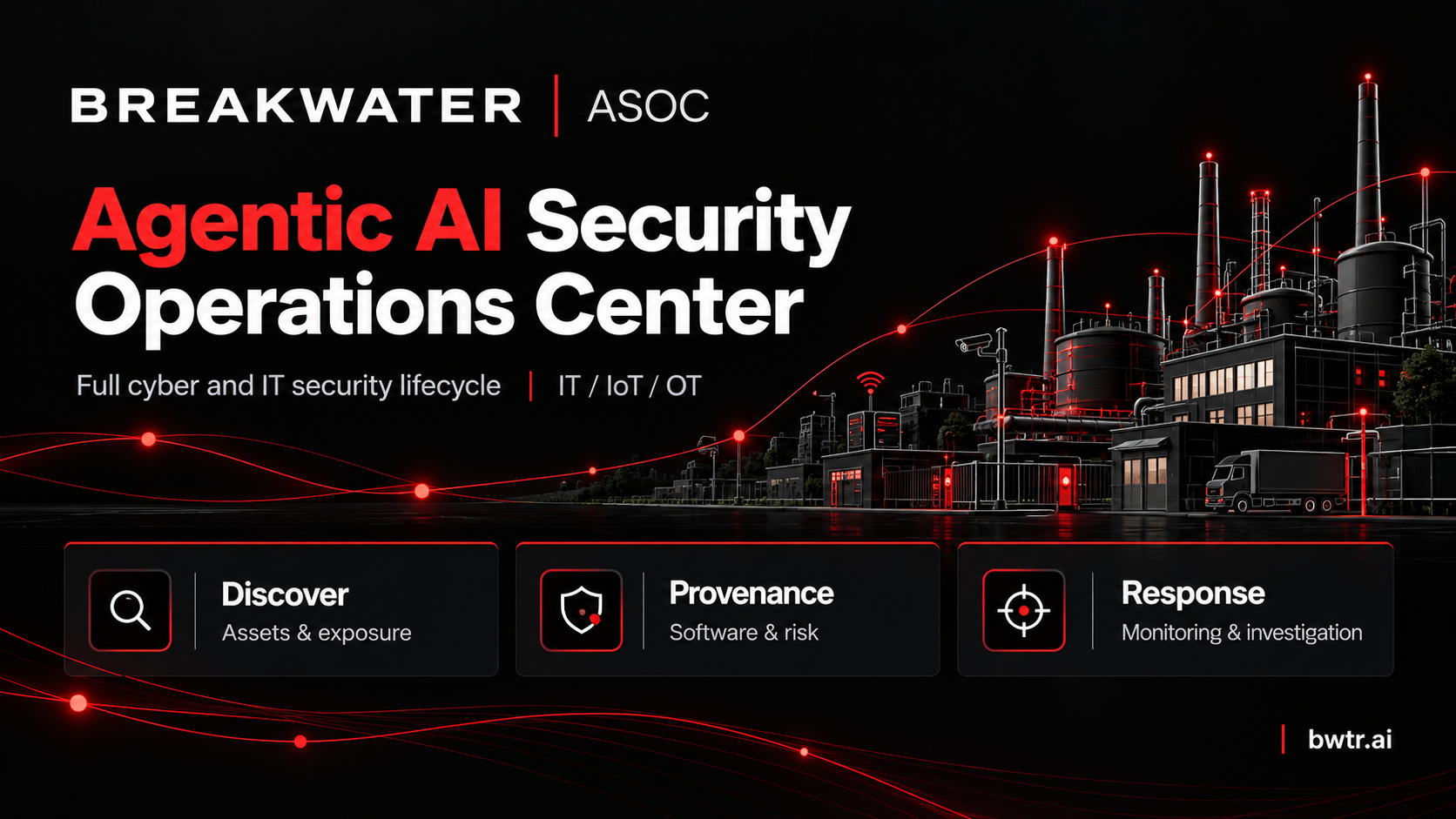
We built Breakwater ASOC as an Agentic AI Security Operations Center for autonomous work across the cyber and IT security lifecycle, spanning IT, IoT and OT, including post-quantum cryptography (PQC) planning. Its three agentic products, Discover, Provenance and Response, address infrastructure exposure, software and cryptographic risk, and ongoing security activity. Customers define the scope of delegated work and retain authority over consequential changes.
A user can ask Discover to investigate an uncertain device identity, Provenance to examine the evidence behind a vulnerability finding, or Response to test whether unusual activity has an innocent explanation. Agents carry out permitted tasks using the tools and records available to each product. When the evidence is incomplete or a requested action is restricted, the case needs to show what remains unresolved.
#Three products, distinct investigations
For the unfamiliar device, Breakwater Discover can examine authorized asset and connectivity evidence, compare identity clues and identify candidate routes toward important services. A service banner or network relationship can guide the investigation, but its source, time and coverage determine how much weight it deserves. The engineer leaves with a specific access relationship to verify, rather than a diagram that implies an intrusion has occurred.
A software advisory may introduce another question: does the reported weakness affect the build running on the workstation? Breakwater Provenance helps agents and engineers inspect vulnerabilities, dependencies and cryptographic use against saved source revisions. Source replay checks whether a cited passage matches the retained code. Establishing deployment and exploitability requires separate evidence. The same source-backed approach helps teams prepare remediation and PQC migration work.
The connection also needs attention while the device and software questions are being checked. Breakwater Response is designed for continuous monitoring and event-driven agentic investigation. Its specialist roles, including the Skeptic, examine competing explanations and identify observations that could distinguish them. Security teams can compare modeled response options and, in supported configurations, test actions in isolated environments. A proposal must account for the service it might interrupt, the authority required and the checks needed afterward.
#Current capabilities and the path ahead
These agent tasks are available today, although the inference systems behind them differ. Discover and Provenance use their own AI connectors and local LLMs; Response uses cybersecurity-adapted models for NVIDIA GPU-backed inference. We plan to extend those specialist models through shared inference services and develop deeper coordination across the products. A single agent carrying an investigation end to end across all three remains a roadmap objective. Collection scope, source revisions and action permissions must remain visible as that work progresses.
In the plant's maintenance case, the first useful outcome may be a confirmed device identity, the supplier's actual access scope and one connection the engineer agrees to check. If a software weakness matters, the team can establish whether it applies to the installed build. A proposed restriction can then be reviewed against the maintenance activity it must preserve. The decision becomes narrower because the unanswered parts have names and owners.
#Start with a case your team already handles
A CISO evaluating Breakwater should bring a case that already consumes analyst and engineering time. Can another reviewer trace an agent's conclusion to the right records? Can operations see what a proposed intervention might disrupt? Does the team spend less time reconstructing the investigation than it does today? Those are questions worth measuring against the existing process, on a system that matters to the business.
The next maintenance window will bring different devices, software and permissions. Security teams will face the same responsibility: find out what the evidence warrants and decide what to do while the operation continues. Breakwater ASOC is built to give agents more of that work without transferring control of critical changes away from the people who run the business.
If an unresolved security question is consuming your team's time, bring us the affected service and the decision you need to make. We can start there.
Explore Breakwater ASOC or prepare a focused proof-of-concept brief.