Reason inside the evidence
Work through an alert, ask for alternative explanations and identify the specific context needed next.

ResponseControlled response & verification
Connect signals, asset context and candidate paths in one on-site investigation. Rehearse the response, route it through explicit approval and verify the outcome with fresh evidence.
Evidence informs. People authorize. Execution and a verified outcome remain separate steps.
8.2 seconds · silent · replay anytime
What action can we safely authorize, and did it work?
Detection and enforcement tools remain essential. Response connects their evidence to AI-orchestrated investigation, digital rehearsal, explicit authority and fresh verification.
AI accelerates the investigation. People retain authority. Fresh evidence closes the loop.
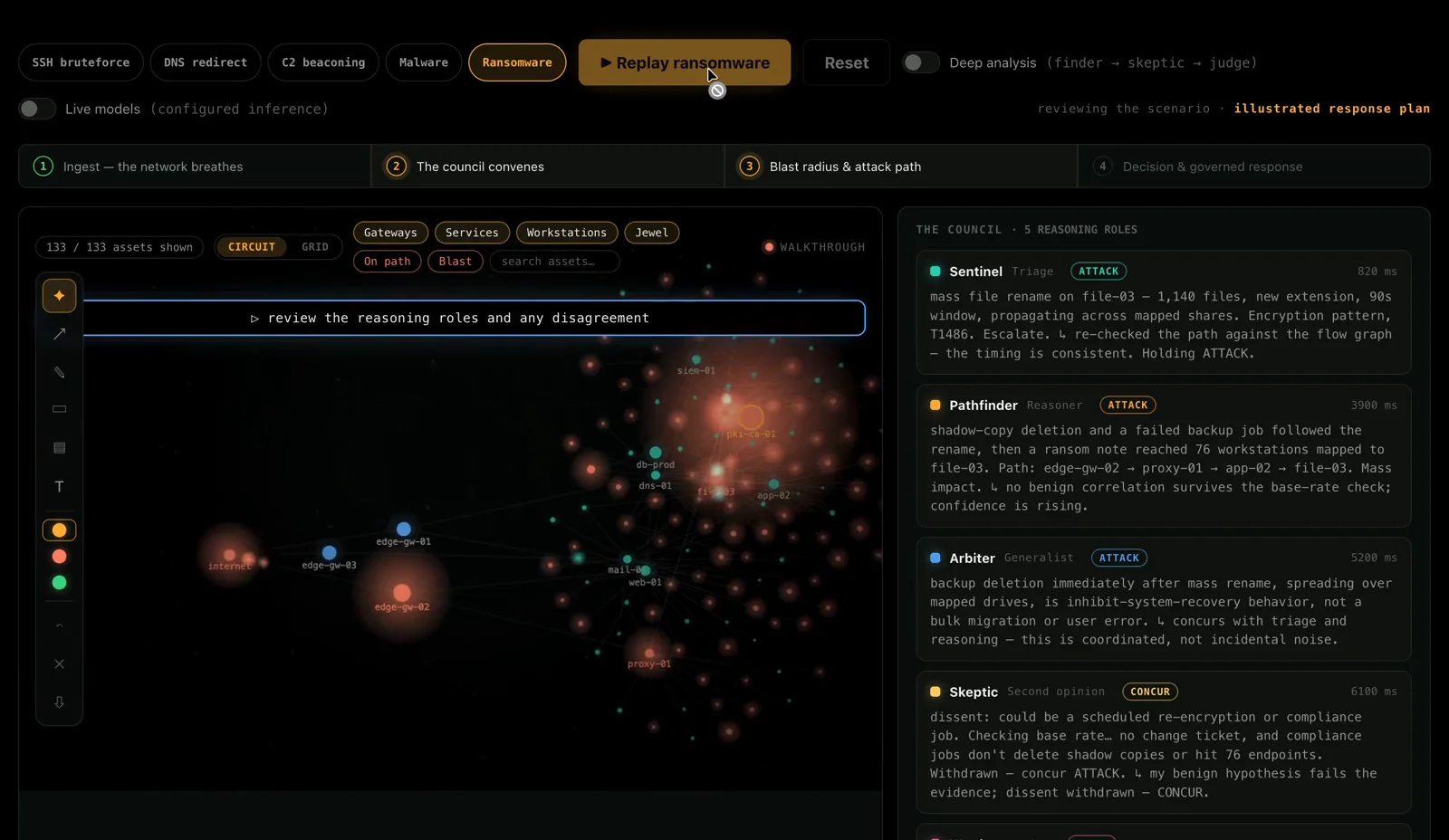
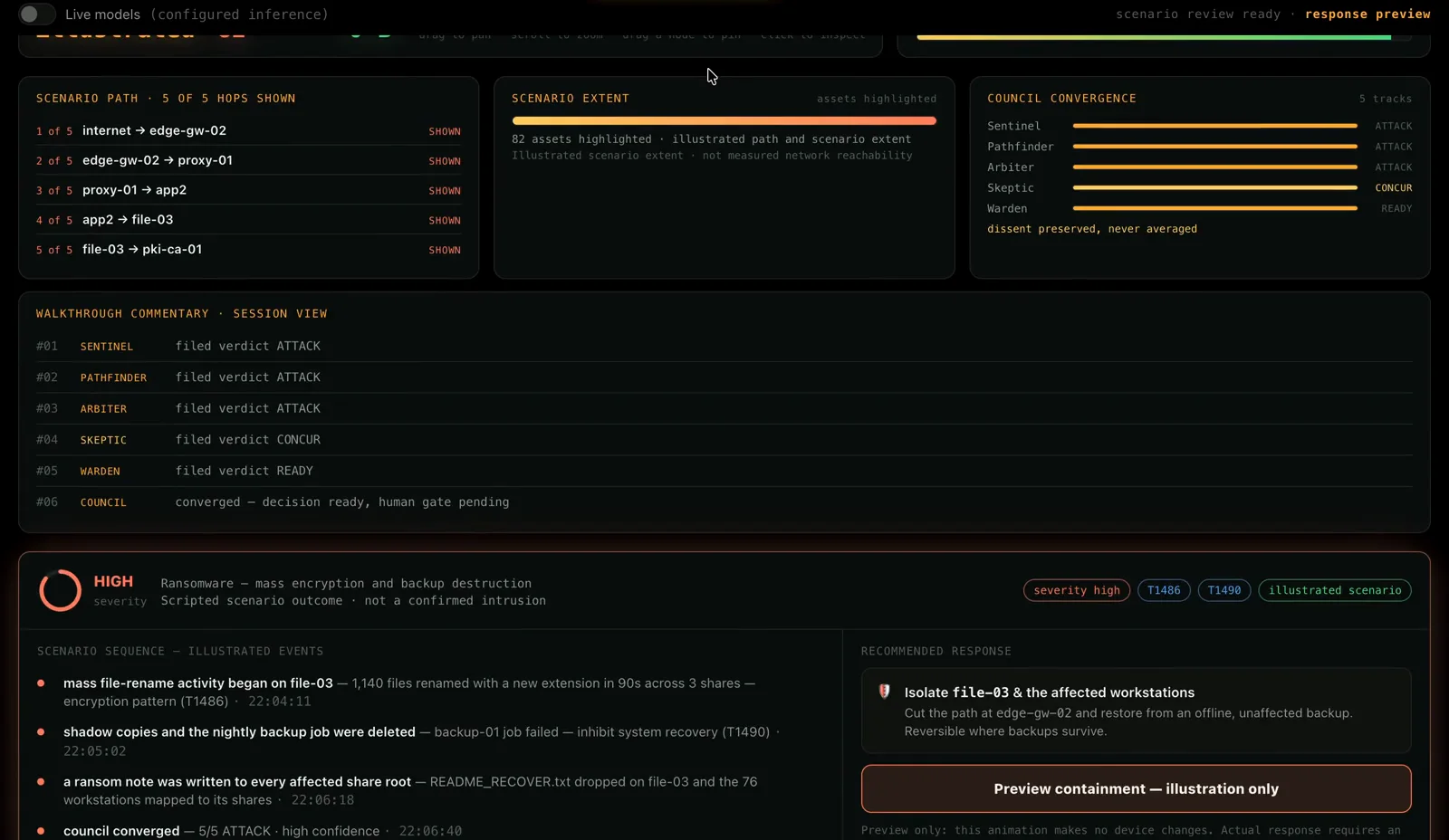
Your SIEM, IDS, EDR and vulnerability tools already collect signals. Response helps the people working those signals determine what they mean, inspect a proposed next step and keep authority with the responsible operator.
Start with the asset, time window, supplied evidence and investigation scope.
Examine observations, candidate paths, timelines and competing hypotheses.
Check target, permissions, impact, recovery, approvals and the evidence still missing.
After an authorized action, collect fresh evidence and determine whether the intended state was achieved.
The useful distinction is whether people can inspect the inputs, challenge the reasoning and govern the next action.
Work through an alert, ask for alternative explanations and identify the specific context needed next.
Inspect operating observations alongside provenance and coverage instead of treating a composite count as a conclusion.
Use inventory and connectivity evidence to examine possible attack paths while retaining the assumptions behind each route.
Review modeled event timelines, digital-twin state and checkpoints before considering a change to the environment.
Review generated queries, scripts, detection logic or control changes as drafts with explicit authority and recovery boundaries.
Keep the authorization record, execution result and post-action verification distinct so success is measured rather than assumed.
Selected recorded workflows show how Response separates reported facts from hypotheses, preserves event origin and keeps operational drafts behind technical review.
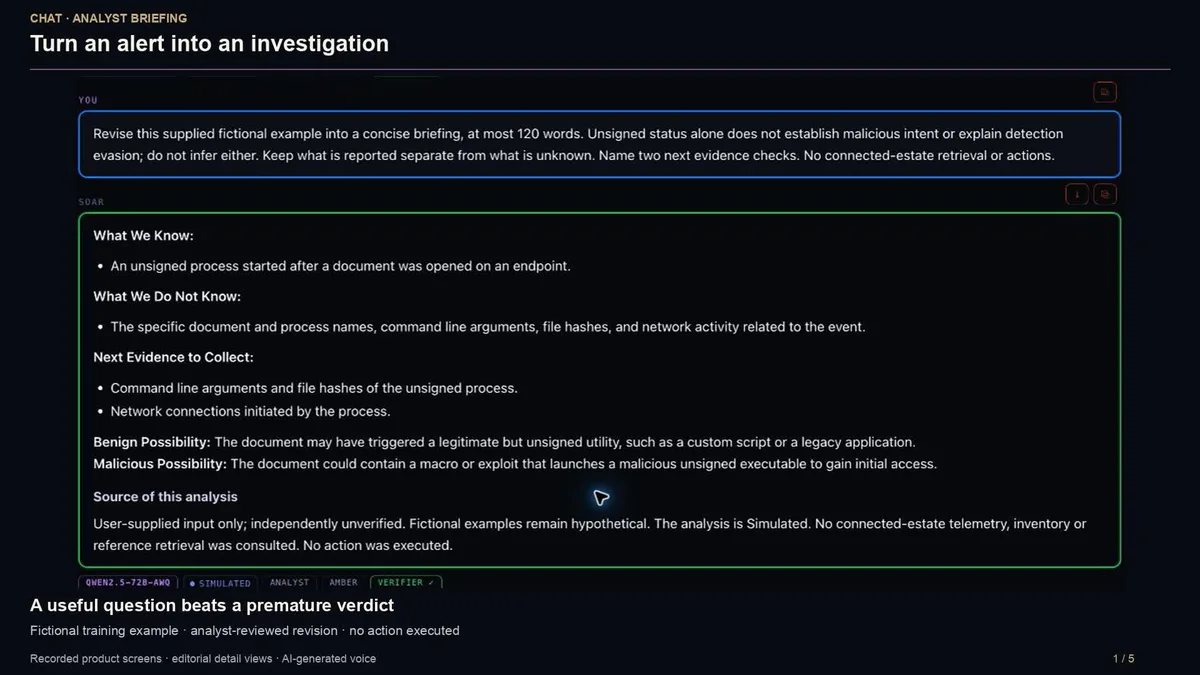
Separate what is reported from what remains unknown, then name the next evidence checks before drawing a verdict.
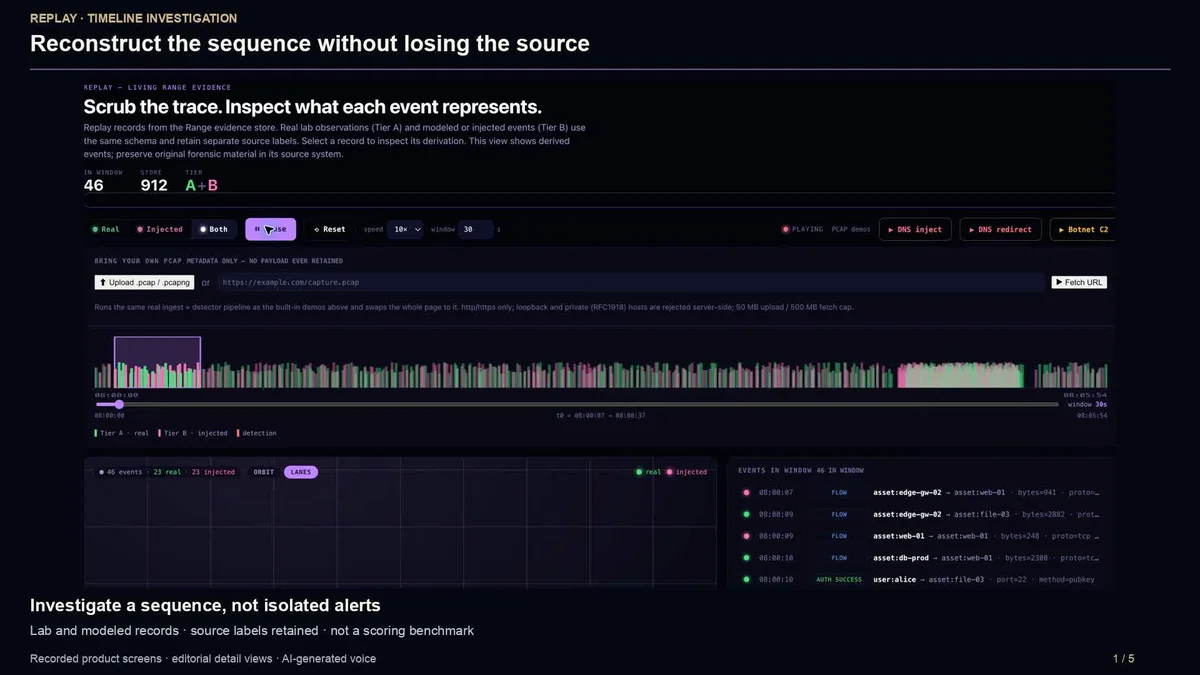
Inspect real, modeled and injected event sources on one timeline without flattening them into the same evidence class.
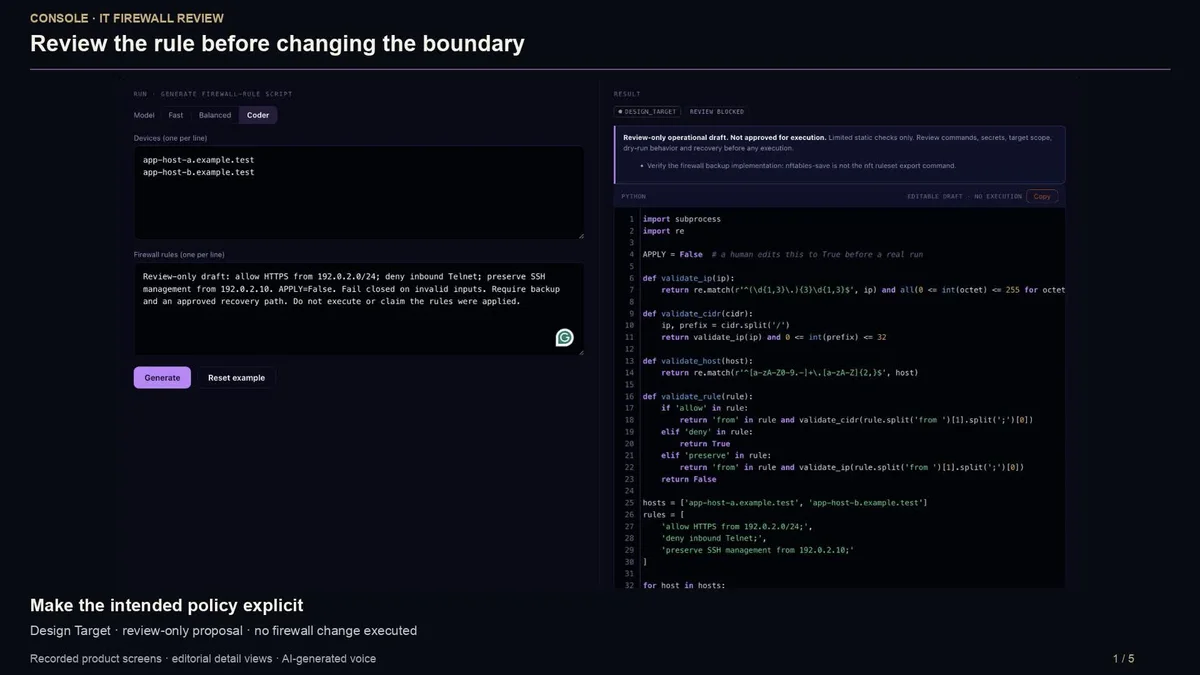
Generated operational code remains an editable, review-blocked proposal until scope, recovery and execution checks are complete.
Response can bring a candidate attack path, modeled asset state and proposed change into a rehearsal that preserves inputs, checkpoints, expected postconditions and rollback references.
A proposed response often depends on identity, reachability, credentials, adapter behavior and recovery steps that are easy to overlook in a ticket. A rehearsal turns those dependencies into reviewable conditions.
Modeled and injected events remain labeled. A rehearsal supports planning and review; it does not prove that the same behavior will occur in production or authorize an operational change.
Digital twin and rehearsal are integrated with investigation, candidate attack paths and governed response instead of being a separate exercise with no decision lineage.
Each role can work from the same evidence while keeping investigation, engineering authority and business accountability explicit.
Investigate a signal without losing the distinction between reported facts, hypotheses and the evidence still required.
Trace candidate routes, examine timelines and turn uncertainty into a focused next evidence request.
Inspect operational drafts, identify unsafe assumptions and review recovery before considering execution.
Ask what is known, what remains unverified, who owns the decision and what authorizes the response.
Response is designed for on-site operation, including environments with tightly controlled connectivity and air-gapped operating configurations. The selected release and deployment controls must be validated for the customer environment.
Choose one alert, hunt or operational review. Confirm supported inputs, named owners, access, retention, approvals and recovery before expanding scope.
Keep SIEM, EDR, IDS, identity, network and endpoint controls as sources and enforcement points where supported adapters are configured.
Review model selection, update paths, data retention and outbound connectivity for the intended restricted or offline configuration.
Validate adapter support, credentials, allowed actions, blast radius, cancellation and rollback for every capability that can affect a target.
Response is designed to make the authority boundary inspectable throughout the workflow.
Detection and correlation tools collect and organize signals. Response focuses on investigating the evidence, comparing explanations, reviewing an operational proposal and preserving the authorization and verification record.
Execution is installation- and capability-dependent. Review the target, credentials, allowed actions, approval route, blast radius and rollback. Generated content alone is never authorization.
No. They support scenario exploration and change planning under stated inputs. Modeled, illustrative and injected records remain distinct from measured events.
Response is designed to support restricted and air-gapped operating configurations. Validate offline updates, local models, supported adapters, retention, identity, credential handling and recovery for the selected release.
Discover establishes what is connected and exposed. Provenance tests what supports the finding. Response governs the operational next step and verifies the outcome.
Bring one alert, hunt or operational review and the people responsible for the decision. We will define evidence, authority and verification before the workflow begins.